What is Vibe Coding? The Paradigm Shift
The era of staring blankly at a blinking cursor, intimidated by complex syntax, is officially over. We have entered the age of vibe coding — a paradigm shift where human creativity takes the driver's seat, and AI handles the boilerplate.
For designers, writers, founders, and visual thinkers, the technical barrier to bringing interactive ideas to life has essentially vanished. Whether you want to build a quick portfolio, prototype a SaaS tool, or just understand what the heck your developer is talking about — this guide will show you how to translate your natural intuition into working software.
Vibe coding is the practice of building software, websites, and digital tools through natural language conversations with an AI agent — focusing on the desired outcome, user experience, and "vibe" rather than writing manual code syntax.
Instead of memorizing div tags, CSS grid properties, or Python loops, you describe what you want. The AI acts as your execution engine — writing, testing, and refining the code based on your ongoing feedback. It bridges the gap between a creative's visual intuition and a developer's technical execution.
The best builders of the next decade won't be the ones who memorize syntax. They'll be the ones who ask the best questions.
Why Claude Code is the Ultimate Creative's Tool
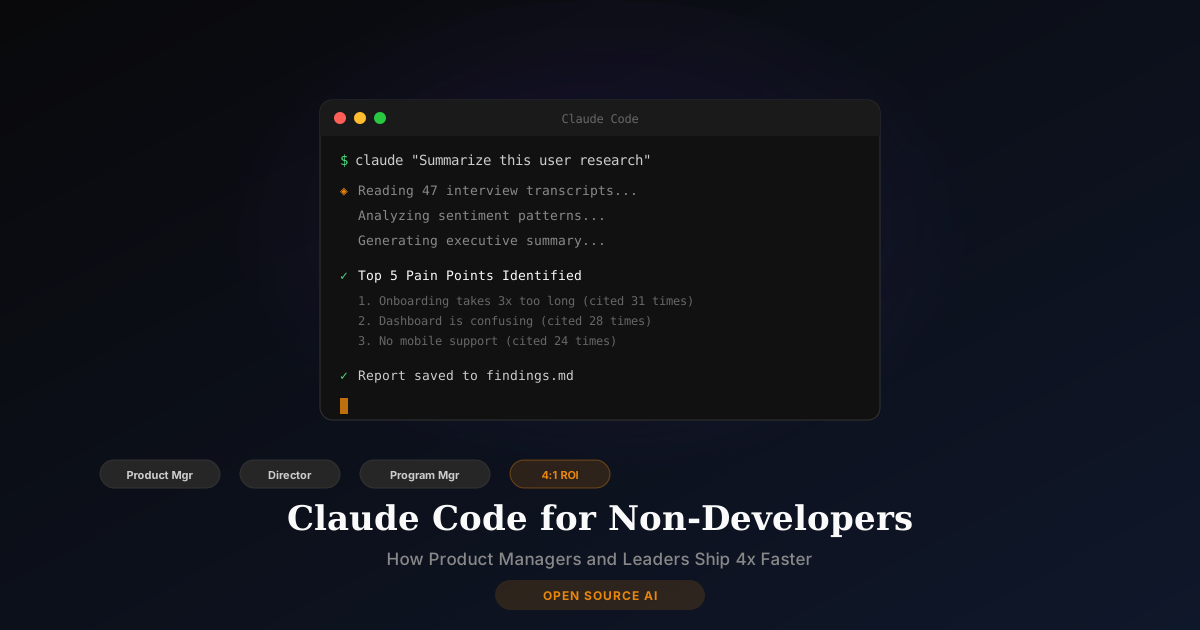
While earlier AI assistants like ChatGPT required you to copy and paste code back and forth between a browser and a code editor, Claude Code operates as an autonomous agent right inside your computer's terminal.
It understands the context of your entire project directory. You can simply ask it to "make the homepage feel more editorial and high-contrast", and it will autonomously navigate your file system, locate the correct CSS or React files, update the styling, and implement the changes.
It acts less like a static reference book and more like a tireless junior developer who executes your creative vision in real-time — without ego, without complaints, and without hourly billing.
Other popular vibe coding tools include:
- Cursor — AI-native code editor with inline suggestions and chat
- Bolt.new — Full-stack apps in the browser, zero setup
- V0 by Vercel — Instant UI generation from text descriptions
- Lovable — Conversational full-stack app builder
- Windsurf — Agentic IDE from Codeium
- Replit Agent — Builds and deploys in one click
Each tool has its strengths, but Claude Code stands out for its autonomy — it doesn't just suggest code, it executes it.
Practical Examples: Turning Vibes into Reality
Example 1: The Instant Interactive Portfolio
The Challenge: You want a sleek, modern portfolio but drag-and-drop builders feel too restrictive, and writing raw React from scratch is out of the question.
The Vibe Prompt:
"Create a single-page portfolio using HTML and Tailwind CSS. I want it to feel minimalist and brutalist. Include a bold, oversized header, a 3-column grid for my projects, and a dark mode toggle. Use large, sans-serif typography with high-contrast colors."
The Result: Claude Code generates the file structure, writes the HTML, applies the styling, and implements the JavaScript for the dark mode toggle — all in one go.
If the design feels too harsh, you simply iterate: "Soften the brutalist vibe a bit by adding rounded corners to the project cards and a subtle drop shadow."
This is the vibe coding loop: describe → review → refine.
Example 2: Automating Mundane Creative Tasks
The Challenge: You have 500 high-resolution images that need to be resized, compressed, and renamed for a web project. Doing this manually drains your creative energy.
The Vibe Prompt:
"Write and execute a Python script that takes all images in my 'raw_photos' folder, resizes them to 1920px wide, compresses them to 80% quality, and saves them in a new 'web_ready' folder. Prefix every filename with 'portfolio_2026_'."
The Result: Claude Code writes the script and runs it. What used to take hours of mind-numbing labor is solved in seconds, freeing you to focus on actual design work.
Example 3: Prototyping Interactive Tools & SaaS
The Challenge: You have an idea for a pricing calculator for your freelance services, or an MVP for a larger product.
The Vibe Prompt:
"Build a pricing calculator web app using React. It needs input fields for 'hours estimated,' a dropdown for 'complexity level', and a checkbox for 'rush delivery'. Calculate the total based on a $75/hr base rate, adding 20% for high complexity and 50% for rush delivery. Make the UI look clean with smooth animations."
The Result: Claude Code builds the logic and the interface. You can immediately expand it: "Add a button to export this estimate as a PDF."
The Vibe Coding Gap: What AI Tools Miss
Here's what nobody in the vibe coding hype machine tells you: AI tools get you 70% of the way there.
The other 30% is what separates a demo from a product people actually pay for. That gap includes:
- Authentication — Secure sign-in, session management, password resets, rate limiting
- Database design — Proper schemas, indexes, migrations, relational integrity
- Payment handling — Webhook verification, subscription lifecycle, refund logic
- Security hardening — CSRF, XSS, SQL injection, secure headers, input validation
- SEO & performance — Server-side rendering, Core Web Vitals, structured data, sitemaps
- Deployment & DevOps — CI/CD pipelines, environment management, monitoring, backups
This isn't a knock on vibe coding tools — it's just reality. A vibe-coded app can absolutely become a production product, but it needs a production review before it gets there.
I've reviewed the code from 20+ AI-generated products. Every single one had at least 3 of the 6 gaps above unfixed. Not because the builder was careless — because the tools never flagged them.
Best Practices for Better Vibe Coding Prompts
To get the most out of your AI co-pilot, you need to master the art of the prompt.
Be specific about the "vibe" — AI understands design language surprisingly well. Use specific aesthetic terms like "bauhaus," "neumorphic," "high-contrast editorial," "cyberpunk," or "warm and minimal" to quickly set the visual direction.
Iterate in small steps — Don't ask for a complex application in a single massive prompt. Build the foundation first, then layer on complexity. Say "add hover animations to the buttons" — then later "make the navigation responsive for mobile."
Provide reference code — If you see something you like, inspect the page, copy the HTML/CSS, and feed it to your AI: "Make my buttons behave exactly like this code."
Name your files and structure early — Ask Claude Code to create a clear folder structure upfront. Chaos in your file tree leads to confused AI responses later.
Always ask for comments — Request that the AI add inline comments explaining what each section does. This turns every project into a learning opportunity.
Is Vibe Coding Right for You?
| You should vibe code if... | You should hire an engineer if... |
|---|---|
| You're building a prototype or MVP | You're building for 100k+ users |
| You want to validate an idea fast | You need SOC 2 / HIPAA compliance |
| You're a non-technical founder | You have time-critical security requirements |
| You learn best by doing | Your stack requires deep optimization |
| You have a limited budget | You're building a core banking or healthcare system |
The truth is, most early-stage founders, solopreneurs, and indie hackers belong squarely in the left column — and vibe coding is genuinely the fastest path to a working product.
Frequently Asked Questions
What is vibe coding? Vibe coding is a method of creating software by giving natural language instructions to an AI agent, focusing on the desired outcome, aesthetic, and functionality — rather than manually typing traditional programming syntax.
Do I need to know how to code to start? No prior coding experience is strictly required. However, having a basic understanding of what HTML, CSS, and JavaScript do (not how to write them) will help you write better prompts and troubleshoot more effectively.
How is Claude Code different from ChatGPT? ChatGPT operates in a web browser where you must copy and paste code manually. Claude Code operates directly in your computer's terminal — it can read your local files, write directly to them, and execute commands autonomously, acting more like an integrated developer than a chat assistant.
Can vibe coding be used for professional projects? Absolutely. Vibe coding is increasingly being used to build MVPs, prototype SaaS tools, create landing pages, and automate internal workflows. With the right production review, vibe-coded apps can absolutely ship to paying customers.
What's the most common vibe coding mistake? Shipping without a security and production review. AI tools build for the happy path — they don't anticipate malicious users, edge cases, or scale. Always get a production audit before you go live with real users and real money.